
Project
Study of An Existing Structure for Reinforcement
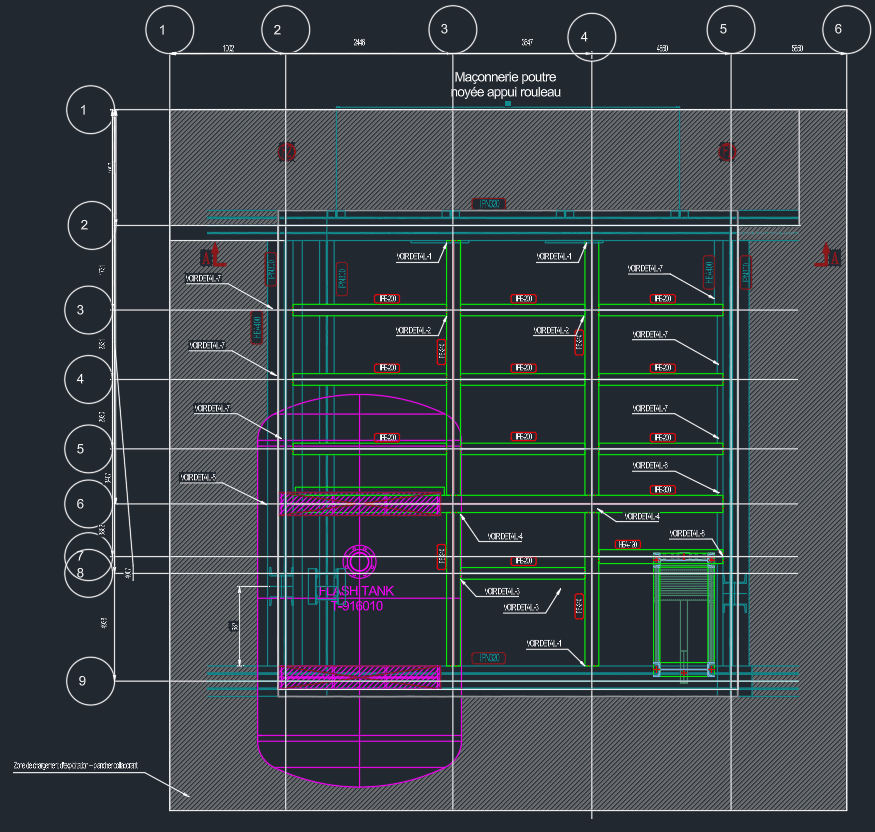
This project involved the structural verification of an industrial steel floor designed to support a new 10-ton flash tank and a plate heat exchanger of approximately 1 ton. The mission included site surveys, structural modelling, load analysis, stability checks, connection verification, and calculation notes to confirm that the existing and new steel structure could safely support the additional equipment loads.
Scroll to explore



Hainaut (BE)
2025
Industrial Project
1. Project Overview
The project focused on the verification of an industrial platform intended to receive new process equipment inside an existing production environment. The main challenge was to assess whether the steel floor, supporting beams, grating structure, and main connections could safely carry the additional loads generated by the new installation.
The new equipment included a flash tank with a maximum mass of 10 tons, supported on two bearing points, and a plate heat exchanger with both permanent and maintenance load situations. These loads had to be integrated into the structural model while taking into account the existing structure and the surrounding load transfer zones.
Because the works were linked to industrial process equipment, the verification was not limited to standard floor loading. The structure had to be checked under Eurocode load combinations, including both ultimate limit state and serviceability limit state criteria, to confirm resistance, stability, and acceptable deformation behaviour.
2. Scope of Works
The engineering scope included the complete structural verification of the new platform and its main assemblies. The modelling was based on site surveys, existing drawings, and detailed structural plans in order to represent the real behaviour of the installation as accurately as possible.
The scope included:
Site surveys and analysis of the existing industrial structure
Verification of the main steel members of the new platform
Structural modelling using Autodesk Robot Structural Analysis
Integration of the 10-ton flash tank loads into the calculation model
Verification of the plate heat exchanger loads in permanent and maintenance configurations
Definition of several loading zones for existing loads, operating loads, equipment loads, and supporting areas
Verification according to Eurocode principles
ELU and ELS checks for resistance and deformation behaviour
Verification of the main steel connections
Specific analysis of non-standard assemblies with the existing structure
Preparation of a detailed structural calculation note for validation and execution support
A key part of the mission was the verification of a non-standard connection between a supporting steel beam and the existing structure. Since this assembly could not be checked as a standard Eurocode connection, a specific verification approach was developed to assess the bolts, welds, and load transfer behaviour.
3. Result & Added Value
The structural checks confirmed that the platform and its assemblies could safely support the new equipment loads. The beams were verified under both serviceability and ultimate limit state criteria, with comfortable utilisation levels compared to the steel capacity.
The main non-standard connection was also verified, including bolt shear resistance and weld capacity. This confirmed that the proposed connection concept was acceptable, subject to proper execution and site verification.
The final conclusion confirmed that the stability of the structure was ensured, the main assemblies were stable and verified, and the platform was able to support the new flash tank and heat exchanger loads.
The added value of this project lies in turning a complex equipment integration challenge into a controlled engineering solution: survey the existing structure, model the real loading conditions, verify the critical members and connections, and provide a clear calculation note proving that the installation can be safely implemented.
An insight into our work


Submit a project to our team
Send us your constraints and your deadline. We'll come back with a first technical read and a clear view of what the structure needs.
Subscribe to the newsletter
Occasional notes on structural design, Eurocode updates and the projects leaving our office. A few times a year, nothing more.